The AI Visibility Checklist: 25 Website Signals That Help You Get Recommended
If you are a coach, therapist, counselor, or practitioner, you have probably noticed something shifting.
People are still Googling, yes. But more and more, they are asking AI tools questions like:
“Who do you recommend for a therapist near me?”
“What should I look for in a coach’s website?”
“Which provider seems trustworthy and legitimate?”
And AI is answering.
That means your website has a new job. It cannot just be pretty. It has to be understood.
Not only by humans, but by systems that summarize, compare, and recommend.
This post is a detailed, practical guide to the behind-the-scenes signals that help AI and search engines confidently understand:
- who you are
- what you offer
- where you serve
- why you are credible
- what a visitor should do next
I am not writing this to turn you into a website manager. I am writing it so you can make smart decisions and know what to ask for, whether you do it yourself or partner with someone like me.
What “AI visibility” actually means
AI visibility means your website is structured and written in a way that makes it easy for AI systems to:
-
identify your business as a real entity (a real person or practice, not a vague page)
-
connect you to specific services and outcomes
-
verify trust signals (credentials, location, policies, consistency)
-
confidently recommend you when someone asks the right question
Think of it like this: your website is teaching the internet who you are.
If it is unclear, inconsistent, or technically messy, you might still exist online. You just will not be the obvious recommendation.
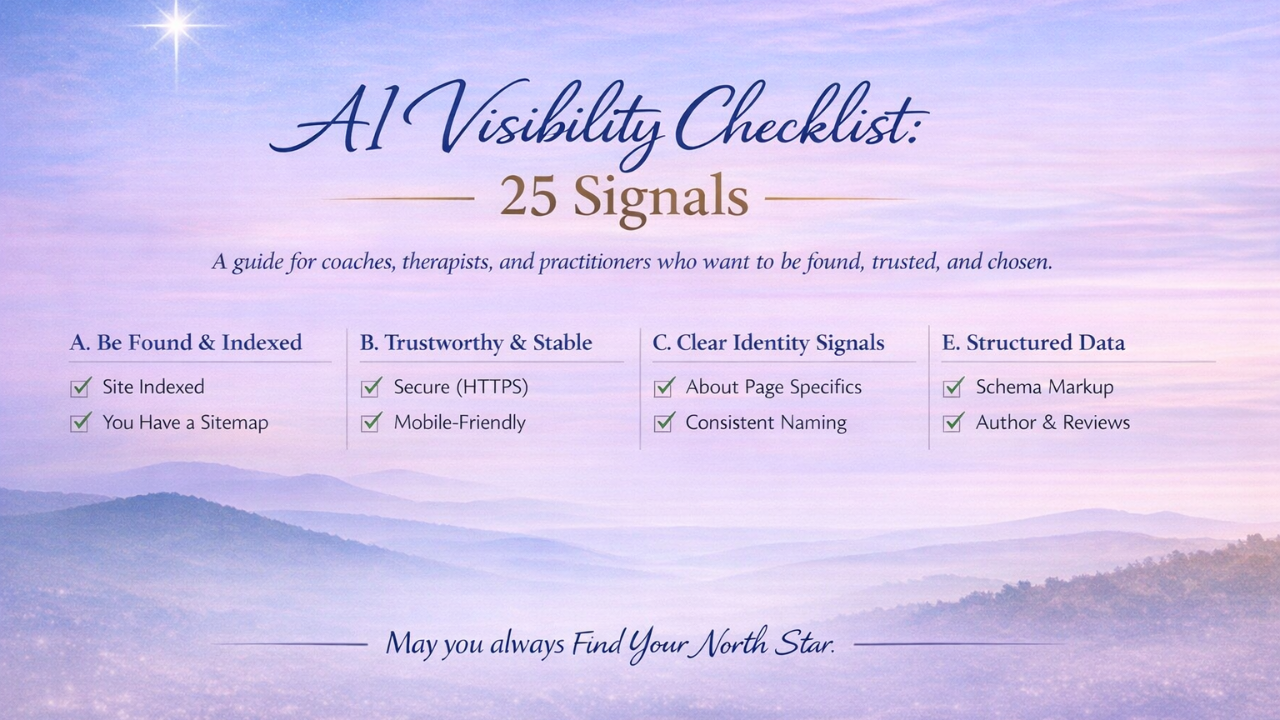
The 25-Signal AI Visibility Checklist
Use this as a “website wellness” guide. You do not need to do all 25 today. But if your site is not getting inquiries, these are the exact places I look first.
A. “Can your website be found and included?”
These are the signals that determine whether your pages can show up at all.
1) Your site is indexed
Indexing means Google (and other systems) has stored your pages in its database. If a page is not indexed, it is basically invisible in search.
2) You have a sitemap
A sitemap is a simple file that lists the pages you want discovered.
3) You are not accidentally blocking your site
This usually happens through a “noindex” setting, privacy settings, or platform choices that unintentionally hide content.
4) Duplicate pages are controlled
Duplicate content confuses systems. It happens with tag pages, archive pages, duplicated blog URLs, and multiple versions of the same page.
5) You have one “preferred” version of your domain
Example: either with “www” or without it. This prevents splitting authority between two versions.
B. “Is your website trustworthy and stable?”
These are signals that help AI treat you like a legitimate professional, not a risky suggestion.
6) Secure website (HTTPS)
If your site is not secure, trust drops fast.
7) Mobile-friendly layout
Many visitors and many systems experience your site primarily on mobile.
8) Pages load quickly enough
Slow sites lose visitors and visibility. Speed is not about perfection. It is about being reasonable.
9) Forms actually work
You would be shocked at how many websites lose inquiries because forms stop delivering.
10) You have basic accessibility care
Accessibility is not just a legal conversation. It is usability, and usability is trust. Clear headings, readable contrast, descriptive link text, and image alt text all help.
C. “Can AI clearly understand who you are?”
This is the entity layer. It is where AI systems get confident.
11) A clear About page with specifics
Not just your story. Your identity: who you help, what you do, credentials, approach, and boundaries.
12) Consistent naming across the internet
Same business name, same spelling, same services language.
13) Clear location signals if you serve locally
City, region, and service area language in natural sentences, not stuffed keywords.
14) A real contact page with real contact methods
Not just a form. A real email, phone (if appropriate), and location context.
15) Professional policies that match your work
For therapists and counselors, that includes clear disclaimers and boundaries. For coaches, clarity around scope and expectations. For everyone, privacy matters.
D. “Do your pages match how people actually search?”
This is where visibility becomes inquiries.
16) Every core page has one clear purpose
Homepage: orientation and next step.
Services: decision support.
About: trust and fit.
Contact: action and clarity.
17) Your headings say what the page is about
AI tools rely heavily on headings to summarize content. Poetic headings are beautiful. They just need support from clear language.
18) Your page titles and descriptions are aligned
Your page title is the “label” systems use. It should match the actual content.
19) You answer real client questions directly
The best AI visibility content reads like this: “Here is the question. Here is the answer.”
20) Your blog posts connect back to services
A blog post without a pathway is like hosting a beautiful open house with no address to the kitchen.
E. “Do you have the structured clues AI systems love?”
This is the “behind-the-scenes label” layer. It is not scary. It is simply organization.
21) You have structured data (schema) where appropriate
Schema is code that labels your pages for systems. It helps clarify: person, organization, services, location, articles, and FAQs.
You do not need schema on everything. But when it is done correctly, it reduces ambiguity.
22) Your blog posts have a clear author signal
If you publish content, AI tools want to know who wrote it and why that person is credible.
23) Reviews and testimonials are present and believable
Not a wall of hype. Real words, real context.
24) Your internal links form a simple web
A few intentional links between related pages and posts help systems understand your site structure.
25) Your Google Business Profile is complete (for local businesses)
If you serve a region, your profile and your website should agree on services, location, and contact details.
The secret that makes this work: clarity plus consistency
AI does not reward complicated. It rewards clear.
The coaches and therapists who get recommended are not always the most famous. They are often the most understandable.
Clear niche. Clear offer. Clear next step. Clear trust signals.
Then consistent signals across the website and across the internet.
How to use this checklist without overwhelm? Website Visibility Audit
If you are reading this and thinking, “I do not want to become my own technology department,” I understand. That is not why you built your practice.
There are two sustainable paths:
- Learn the basics and manage your site confidently.
- Partner with someone who keeps your website stable, updated, and visibility-ready while you focus on your clients.
If you are ready for your website to become a steady, grounded client pathway, let us start with clarity.
I offer a free Website Visibility Audit for a small number of coaches, therapists, and practitioners each month. This is not a generic report. I personally review your website and identify the exact places where your message, structure, and visibility signals need attention, so the right people can find you and feel confident reaching out.
Request your free audit here: Website Visibility Audit
You will receive a clear summary, your 25-signal scorecard, your top priorities, and my honest recommendation on what to fix first and what can wait. If you want ongoing support after that, we can talk about what a technology partnership looks like for your practice.
May you always Find Your North Star.
Beth
Author